A driving day does not count, people think. As though the trip only starts once you are through the park gate.
There are two hundred and thirty kilometres between Moshi and Karatu, around a hundred and forty miles, and you are about four hours doing it. In those four hours you see more of how Tanzania works than you will in any park. You just have to look out of the window instead of at your phone.
A tube of tarmac
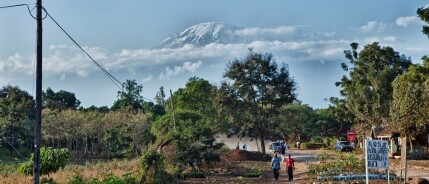
The road lies in the landscape as though somebody squeezed it out of an enormous tube of tarmac. One strip, and immediately beside that strip the surface stops. No verge, no crash barrier, and markings on only part of the route.
Which means everything that moves shares that same strip. Lorries, buses, motorbikes, cyclists, goats and people, all on the same two hundred and thirty kilometres.
With an engine
All sorts of things drive along beside you. Gleaming new pick-ups done up with trim, and next to them cars so old the headlights have stopped working and the canvas is coming through the tyres. Mercedes trucks that look immaculate, and lorries crawling up a hill in first gear with a queue of cars behind them.
The motorbikes are light, Chinese-made and covered in chrome. The buses between the towns drive hard and overtake where they should not. The daladalas, the minibuses, stop every few hundred metres because somebody always wants to get on or off.
And almost everything is painted. A football club across the tailgate, a line of scripture on the windscreen, a name in curling letters down the side. You read what people care about as you go.
And without one
In between all of that goes everything with no engine at all. Cyclists with a stack of firewood on the rack, no lights, even once it is getting dark. Women in bright kangas with a basket or a jerrycan on their heads, upright, at a pace you could not match.
A herd of goats with a boy of about twelve behind them. Donkeys with too much on their backs. The traffic and the foot traffic run through each other here, and it does not always go well, so your driver drives differently here than you would at home.
And you see Maasai walking, recognisable by their tall slim build and their clothing. Often with a phone in one hand next to the staff. That picture is the true one, even if it does not match the brochure.
Straight through Arusha
Halfway along lies Arusha, and there everything changes. It becomes a city, it becomes busy, and it becomes loud. You sit still in traffic, people call out, and it takes you about an hour to get through.
Your driver will probably ask you to close your window while you are stationary. Not because it is dangerous to be in Arusha, but because a camera on your lap beside an open window is a camera somebody can take. That is practical advice, not a warning.
There is also a route that avoids the centre. In season the jacarandas along it are in flower, purple right across the road. If the timing works out, we drive that one.
From Arusha to the turn at Makuyuni
After Arusha it goes back to what it was. There is a good hundred kilometres still to go to the turn, around sixty miles, and the villages come at intervals.
A market at every one. Tomatoes stacked in pyramids, red onions, mangoes, avocados, all of them point upwards with the top one balanced exactly. Barbecues at the roadside with goat and chicken on them. It smells good and it looks good.
Three things your guide will tell you here. Drink far more water than you think you need, wash your hands regularly, and do not eat the street food. That last one is no judgement on the food, it is a stomach that is not used to what is normal here, and you do not want to be sitting in the park tomorrow with cramps.
Further back from the road you see bomas. A Maasai homestead with a kraal for the livestock in the middle and the round huts around it. The cattle stand inside at night and the people around them, and that is exactly why it looks the way it does.
The climb to Karatu
At Makuyuni you turn right, onto the B144. Narrower, quieter, and from there you climb. It is the middle of the afternoon by now and it has got hot.
The landscape changes with you. Greener, higher, and at some point you are driving between the fields and the coffee of the highlands. Then you are nearly there.
What comes after that is the part everybody talks about. The pool, a cold glass, the sun going down, dinner, and an early night. Because tomorrow the alarm goes at six and the other half of this starts.
How long the drive from Moshi to Karatu takes
Reckon on about four hours of driving for the two hundred and thirty kilometres, of which an hour or so is getting through Arusha. In practice the day takes longer, and that is on purpose.
We do not plan this drive as a transfer, we plan it as a day. You stop at a market, you get out where it is worth getting out, and you eat somewhere along the way. Anybody who does it in four hours has driven it. Anybody who makes a day of it has seen it.
What your guide does along the way
This is the difference between a transfer and a driving day. Your guide is not only driving, he knows where to stop.
He tells you what you are looking at before you have to ask. Why that kraal sits in the middle, what is painted on that tailgate, why that lorry is in first gear. And he knows which road is passable after rain and which is not, which in the wet months is the difference between four hours and seven.
You drive this route on almost every northern trip, because it is the road from Moshi to the parks. How that day falls inside a full programme, you can see in our itineraries.