Tanzania currency, cash and tipping
Tanzania weather
The population of Tanzania
What language is spoken in Tanzania?
Is Tanzania safe?
Vaccinations for Tanzania
Malaria in Tanzania
Which airport you fly into in Tanzania?
[...]

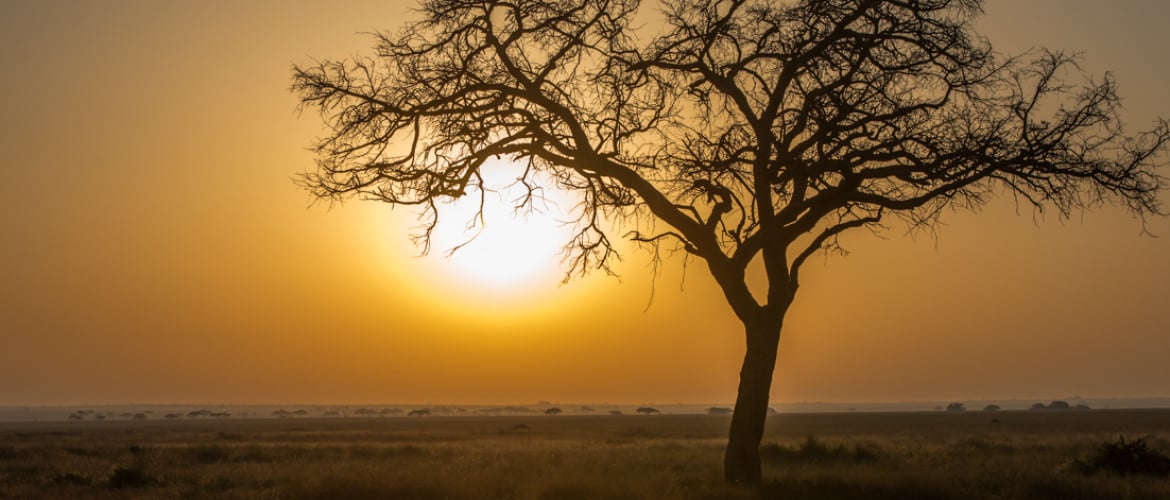
Tanzania lies just south of the equator and is warm all year, but how warm depends more on altitude than on the month. In Arusha, at 1,400 metres, daytime temperatures sit between 20 and 28 degrees. On the coast in Dar es Salaam it is between 30 and 33. The country has two rainy seasons, the long rains from March to May, and the short rains in November and December.
The long rains, March to May. They usually start in mid-March, April is the wettest month, and they fade out over the course of May. It rarely rains all day. More often a heavy shower comes in late in the afternoon or at night, and the mornings are often clear.
The short rains, November and December. Shorter and less predictable. Sometimes a shower late in the afternoon, sometimes a few days of rain on and off.
Dry from June to October, and little rain falls in January and February.
For the last months of 2026, extra rain is expected because of El Niño. That applies to this year, not to every year.
Arusha, the north, 1,400 metres. The gateway to the safari parks.
Month | Day | Night | Rain |
January | 28 °C | 10 °C | 50 mm |
February | 28 °C | 10 °C | 80 mm |
March | 27 °C | 11 °C | 170 mm |
April | 25 °C | 13 °C | 360 mm |
May | 22 °C | 11 °C | 210 mm |
June | 21 °C | 8 °C | 30 mm |
July | 20 °C | 9 °C | 10 mm |
August | 22 °C | 8 °C | 10 mm |
September | 24 °C | 8 °C | 20 mm |
October | 26 °C | 10 °C | 30 mm |
November | 27 °C | 10 °C | 110 mm |
December | 27 °C | 10 °C | 100 mm |
Dar es Salaam, the coast, sea level.
Month | Day | Night | Rain |
January | 32 °C | 25 °C | 54 mm |
February | 33 °C | 25 °C | 71 mm |
March | 32 °C | 24 °C | 170 mm |
April | 31 °C | 23 °C | 264 mm |
May | 30 °C | 22 °C | 172 mm |
June | 30 °C | 20 °C | 31 mm |
July | 30 °C | 19 °C | 16 mm |
August | 30 °C | 19 °C | 18 mm |
September | 31 °C | 20 °C | 20 mm |
October | 32 °C | 21 °C | 77 mm |
November | 32 °C | 23 °C | 114 mm |
December | 32 °C | 24 °C | 110 mm |
Averages over several years. Any single year can turn out wetter or drier.
The Serengeti, Tarangire and the Ngorongoro Crater lie higher than the coast, and you feel it. Days are usually between 25 and 28 degrees.
From June to September the mornings are cold. You set off at six, the roof of the vehicle goes up and you feel the air on your face. Bring a fleece and a windproof jacket. By ten you are taking them off again.
On the rim of the Ngorongoro Crater, at over 2,300 metres, evenings and mornings are cool all year round.
From June it gets dusty. Every vehicle trails a plume of red dust. A buff or a scarf over your mouth is no luxury.
What to bring for that weather is on our packing list for Tanzania.
Zanzibar sits in the ocean and is warm all year. There, the wind matters more than the temperature. Everything about it is on our page on the best time to visit Zanzibar.
If you come in April or November expecting to spend the whole day in your tent, you will be proved wrong. The rain comes in showers. A game drive interrupted by a thunderstorm is often the one people remember longest. And after the first rain on dry ground, the Serengeti smells of wet earth and grass. No photo holds it, and everyone talks about it.
Which month suits your trip is on our page on the best time to visit Tanzania.
Which route we drive in which month, and why, is worked out day by day in each of our itineraries.