
Safari packing list for Tanzania, everything you bring
This list is for a safari in Tanzania of around two weeks, with Zanzibar on the end if you are going. Travelling shorter or differently, it still works, you just leave a few things out.
One number decides the rest of this page, and that is your baggage allowance on the domestic flight. Usually twenty kilos of hold luggage plus five kilos of hand luggage, so 44 pounds plus 11. A few of the smaller flights do fifteen plus five. Whatever applies to your flight is on your e-ticket, so look there before you start packing.
Your luggage, and why it is a soft bag
Bring a soft bag or a duffel, not a hard case. That is not for show. In the hold of a small aircraft and in the back of a Land Cruiser a soft bag goes in among the rest, a hard case does not.
Pack under your limit rather than up against it, because you will buy something along the way. And bring a laundry bag made of cloth, not plastic, because plastic bags are banned here and your dirty clothes have to go somewhere.
Alongside that, a small day bag or rucksack that can sit on your lap in the vehicle. Everything you need during the day goes in it, so you are not digging in the back every time.
Documents, and what you arrange yourself
Your passport has to be valid for at least six months on arrival, and it needs empty pages.
You arrange your visa yourself, online, before you leave. If you are going on to Zanzibar, there is a compulsory insurance for the island on top of that. After you book we send you an email setting out exactly which steps to take and in what order.
Bring your travel insurance with the policy details, your vaccination record, and a copy of your passport kept separately from the original. A photo of everything on your phone and in your email takes two minutes and saves you a day if something goes missing.
Clothing, and how much you need
Less than you think. The lodges will do your laundry for a fee, so you do not have to pack for fourteen days. Count on four to five days of clothing and have the rest washed.
Neutral colours work best. Beige, olive, sand, grey. Not because animals see you otherwise, but because dust shows less on them and because bright white stops being white after one day.
Long sleeves and long trousers for early mornings and evenings, against mosquitoes and against the cold, because it gets colder after dark than you expect, and colder again at altitude near the Ngorongoro Crater. Short sleeves are fine out in the field during the day.
Bring one warm layer, a fleece or a heavy jumper, and a thin windproof jacket. Travelling in the wet months, add a rain jacket that folds small. And something to sleep in that is warm enough, because in a tented camp at altitude the temperature drops.
For towns and villages, shoulders and knees covered. That is the norm in public here and there are fines on paper for it. At your lodge and by the pool it does not apply. Going on to Zanzibar, bring a sarong or a light long skirt or trousers for away from the beach.
And something for your head. A cap, a hat or a scarf, because you spend a lot of the day with your head through the open roof, and in a moving, dusty vehicle that is more welcome than it sounds.
Beyond that the ordinary things you would pack anywhere. Underwear, socks, nightwear, swimwear, a belt, and jewellery if you wear it. If you wear contact lenses, bring your glasses too, because dust and lenses do not get on.
Shoes
One pair of closed walking shoes or sturdy trainers that you have already broken in. New shoes on day one is the fastest way to spend the whole trip thinking about your feet instead of what you came to see.
Alongside those, flip flops or sandals for camp and the beach, and if there is a waterfall on your programme, something that can get wet. You do not need mountain boots unless you are climbing, and that is a different trip.
Toiletries and health
Sun cream of at least factor 30, more than you think you need. You are at altitude, the sun is stronger here, and through the open roof you get more of it than you notice. Add a lip balm with a factor in it and an aftersun.
Insect repellent with DEET for the evenings, and sunglasses you would not mind losing.
Your own medication goes in your hand luggage, not in the hold, with a note from your doctor if it is anything unusual. Alongside that a small first aid kit. Plasters, painkillers, something for diarrhoea, a thermometer, iodine or antiseptic wipes and some gauze. And hand gel, because you wash your hands less often than at home.
On malaria and vaccinations we give no advice, that belongs with your doctor or a travel clinic. What we do say is start early, because some vaccinations need preparation time.
Camera, binoculars and power
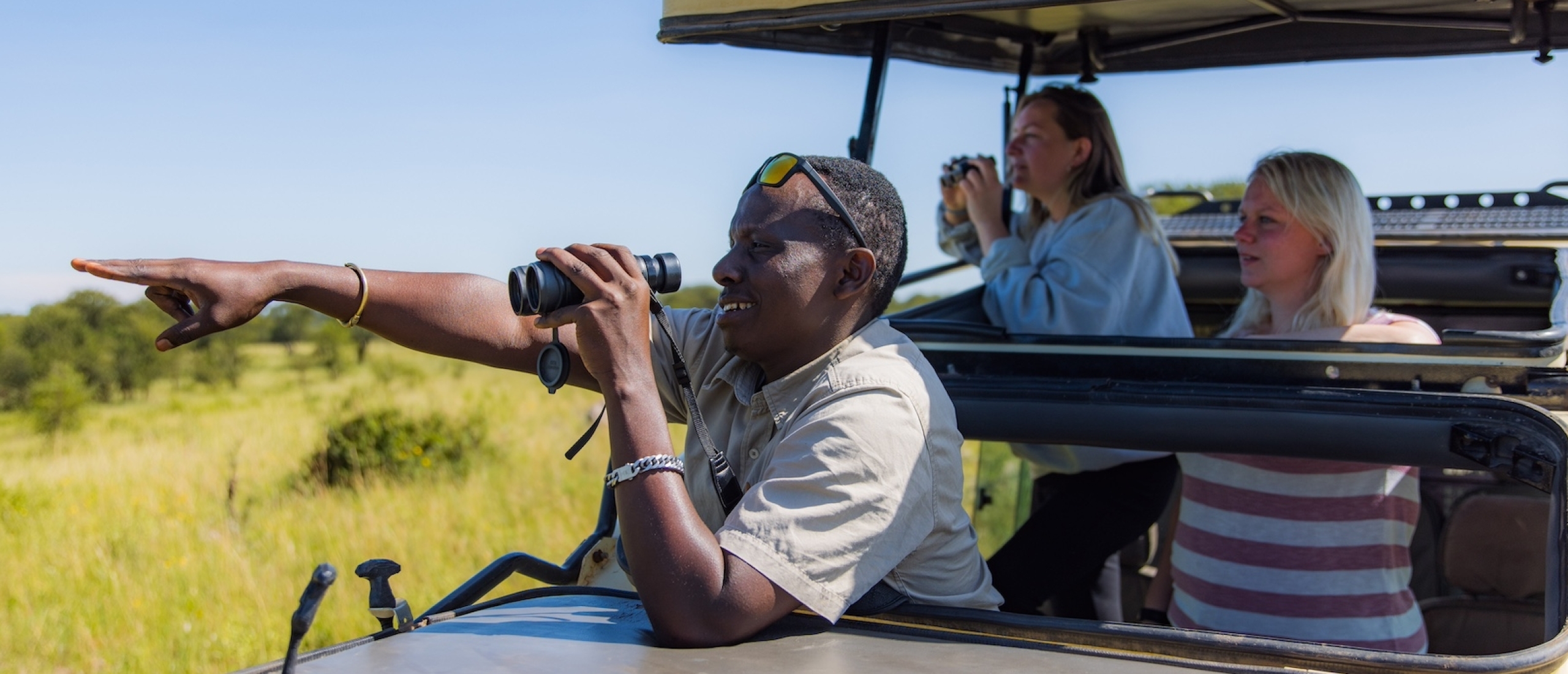
Binoculars are the thing guests mention most afterwards. Not a camera, binoculars. You see things with them that you would otherwise miss, and you share them around the vehicle. Workable sizes are 8x32, 8x42 or 10x42.
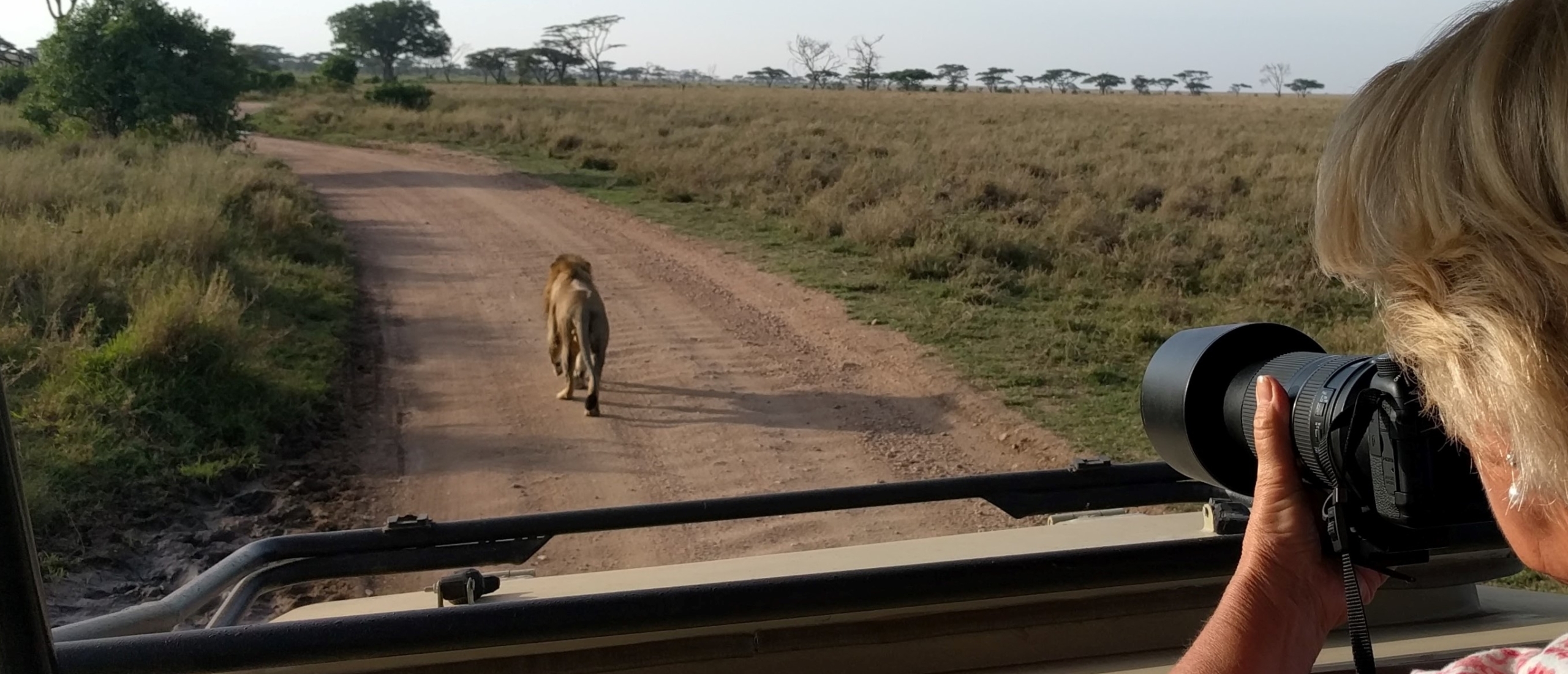
If you photograph seriously, 70 to 300 millimetres is the range that earns its place on safari. Going further, 600 millimetres gets you closer to the animals than you will ever get yourself, and you carry it the whole trip. A phone does the landscape well and animals at distance badly.
Power is not something to worry about. You can charge your phone and camera in the safari vehicle, so one power bank is enough and three spare batteries are not needed. Note that your power bank has to travel in your hand luggage, not in the hold. Tanzania uses the British three pin plug, type G, and in older places you also meet type D with three round pins. A universal adapter covers both.
Beyond that, more memory cards than you think you need, your charger, and something to keep dust out of your camera. A cloth and a cover are enough, but the dust here gets into everything.
Money, and which bills are accepted
This is the part that is written down nowhere else properly, and the part people come unstuck on.
Bring cash dollars for tips. Watch the year on them. Bills from 2009 or newer are accepted, older bills are not. It sounds strange and it is simply the case, so ask your bank for them.
For shillings you do not need to arrange anything in advance. You can withdraw cash in Moshi and Arusha, and your guide will stop at a cash machine along the way if you ask. That does not need planning, just say so in the vehicle.
On tipping we get asked for a number constantly, and we would rather give you one than have you guess. For your safari guide, thirty-five to fifty dollars a day is usual, and that is per vehicle and not per person. In the lodges there is normally a shared tip box, and one figure is hard to give there because it differs by place. Ask us and we will think it through with you.
Internet and staying reachable
For internet we recommend an eSIM, through Airalo for instance. You arrange it at home before you leave, it is ready the moment you land, and you have nothing to do at the airport.
Beyond that, save your maps offline before you go, and download whatever you want to read or listen to. There is no signal in large parts of the parks, and that is usually the best part of the day.
In your day bag, for the vehicle
This is the bag you pick up in the morning and keep with you all day.
What | Why |
Binoculars | The most used object of the whole trip |
Sun cream and lip balm | Through the open roof you get more sun than you notice |
Cap or hat, sunglasses | Same reason |
Refillable water bottle | There is water in the vehicle, so you need not work through plastic bottles |
An extra layer | Early morning is cold, by midday it is not |
Camera, cards, cloth | Dust gets into everything |
Some cash | For along the way, at a market or for a village contribution |
Head torch or torch | Many flights into Kilimanjaro land in the evening, so your first arrival is in the dark |
Snacks or bars | In sealable bags, because loose in a bag they become crumbs |
A pocket knife | Not a must, useful at the picnic lunch |
A wildlife or bird guide | Looking alongside your guide and finding things yourself is half the pleasure |
Something to read | The transfers between parks take hours, and not every hour is spectacular |
What to leave at home
Three things you should not bring.
Camouflage clothing. In Tanzania that is reserved for the military and civilians may not wear it. It is about the pattern, not the colour, so olive green is fine and camouflage print is not. This applies to children’s clothes and to that one rucksack as well.
Plastic carrier bags. They are banned here and it is checked on arrival. Take them out of your case before you leave, including the ones your liquids are in. You can buy a cloth bag at any market here.
A drone. Drones need permission in advance in Tanzania and are not allowed in the parks without a permit. Assume the answer is no unless you have arranged it with us well beforehand.
What you do not need to bring
Some of what appears on other packing lists can stay at home, and that saves kilos you will want.
The accommodation provides mosquito nets, towels, beach towels, shampoo and soap. So there is no need to carry your own towel or put bottles of shampoo into your twenty kilos.
And you do not need clothing for the whole trip, because the lodges will do your laundry for a fee. Four to five days is enough.
The packing list in short
Everything in one place, to tick off while you pack.
Category | Bring |
Luggage | Soft bag or duffel. Day bag or rucksack for the vehicle, which also works as hand luggage. Cloth laundry bag. Check your weight limit on your e-ticket |
Documents | Passport, valid six months. E-visa arranged in advance. Tickets or boarding pass. Travel insurance with policy. Vaccination record. Bank cards. Copy of passport, kept separately |
Clothing | Four to five days in neutral colours. Long trousers and long sleeved shirts for morning and evening. Shorts, skirts, T-shirts. One or two jumpers. Warm layer and thin windproof jacket. Rain jacket in the wet months. Cap, hat or scarf. Underwear, socks, nightwear. Swimwear and beach clothing for Zanzibar. Belt and jewellery to taste |
Shoes | Broken-in closed shoes. Flip flops or sandals. Something that can get wet |
Toiletries | Sun cream factor 30 or higher, for lips and face too. Aftersun. DEET or similar. Sunglasses. Your own toiletries and toothbrush. Lenses plus glasses |
Health | Your own medication in hand luggage. Malaria tablets as your doctor advises. First aid kit with plasters, painkillers, thermometer, iodine or antiseptic wipes, gauze, something for diarrhoea. Hand gel |
Optics and tech | Binoculars 8x32, 8x42 or 10x42. Camera with a 70 to 300 mm lens, spare memory cards, battery, charger, cloth and cover. Phone and charger. Power bank in your hand luggage. Universal adapter for type G and D. eSIM arranged in advance. Tablet, e-reader or GoPro if you want |
Money | Cash dollars for tips, bills from 2009 or newer. Bank card for shillings on arrival |
In the day bag | Torch or head torch. Snacks in sealable bags. Pocket knife for the picnic. Wildlife or bird guide. Something to read for the long transfers. Refillable water bottle |
Leave at home | Camouflage print. Plastic bags. A drone without permission arranged in advance. Hard case. Towels, shampoo, soap and mosquito net, those are provided |
Frequently asked questions
How much luggage can I bring on a safari in Tanzania
On the domestic flights it is usually twenty kilos of hold luggage plus five kilos of hand luggage, and on a few of the smaller flights fifteen plus five. It is always on your e-ticket.
Why not a hard case
It does not fit well in the hold of a small aircraft or in the back of the Land Cruiser. A soft bag goes in among the rest, a case does not.
What colours do you wear on safari
Neutral, so beige, olive, sand or grey. Camouflage print is forbidden for civilians in Tanzania. Bright white gets dirty fast, and bright colours are not needed, though you will not see one animal fewer for wearing them.
Can I have my laundry done
Yes, in the lodges, for a fee. That is why you do not need to pack for the whole trip.
Can I charge my phone along the way
You can charge your phone and camera in the safari vehicle, and there is power in the lodges. One power bank is enough.
Which dollar bills are accepted
Bills from 2009 or newer. Older ones are refused, even when they look fine.
Do I need to bring shillings from home
No. You can withdraw cash in Moshi and Arusha, and your guide will stop at a cash machine along the way if you ask.
Do I need binoculars
Not strictly, but it is the object guests say most about afterwards. Workable sizes are 8x32, 8x42 and 10x42.
Do I need to bring towels and toiletries
No. Mosquito nets, towels, beach towels, shampoo and soap are provided in the accommodation. Your own toothbrush and toiletries you do bring.
Which lens do I bring on safari
Seventy to three hundred millimetres covers nearly everything you will want to photograph. Six hundred millimetres gives the best close-ups and weighs accordingly.
Can my power bank go in my suitcase
No, it has to be in your hand luggage. That is an aviation rule, not one of ours.