The tarmac runs out about three quarters of an hour after you leave Moshi.
From there it is sand and stone through dry hill country, and you want a vehicle that can take it. Eighty kilometres west of Moshi, around fifty miles, a little over an hour and a half in all. We spent a weekend out there, so this is what to expect.
Where it is and how you get there
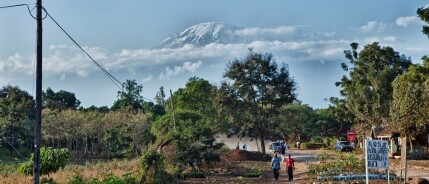
West Kilimanjaro, eighty kilometres west of Moshi. The country dries out as you go, the vegetation drops lower, and the land opens up. On a clear day Kilimanjaro stands on the far side of the plain.
Nobody passes through here by accident. There is no through traffic, so it is quiet, and in the evening the only thing you hear is whatever is going on outside.
Even if a cultural visit is not the reason you came, the country out here earns the drive. An open plain to the horizon, a mountain that looks different every hour of the day, and evenings by the fire where you can see further than you can at home. The landscape stands on its own.
Amini or Osiligilai, two lodges with the same experience
We work with two lodges in West Kilimanjaro, Amini Maasai Lodge and Osiligilai Maasai Lodge. They have the same atmosphere and they give you the same experience.
Which of the two you get depends on your dates, how many of you there are, and where you go next. Availability often settles it, because both of them fill up. We make the choice and we tell you why.
Who set this place up
Both lodges were set up by the Maasai community of the area and are connected to it, and they are run by people who live there. That is the reason we work with them.
You sleep on Maasai land, in a business the community built, and you pay for it. That is not charity and it is not a performance, it is a transaction between two parties. It also settles what you are while you are there. You are not watching, you are staying.
When you arrive you are welcomed with singing by the people who keep the place running, from the kitchen through to the guides. After that a camp manager takes you through how a day here works, in English.
How you sleep
You have your own hut, a good bed, hot water, and a bath looking out over the plain. The food is solid, and if you have a dietary requirement, tell us beforehand and it is arranged.
Comfort here is not a Western addition to something older. It is planning. You cannot sleep in a working boma, and this was built to put guests up, on the land of the people who run it.
This is one night inside a trip that runs through camps and lodges we know ourselves, because we chose them. Where you sleep across the rest of the route is on our accommodation page.
What you do there, and what happens anyway
In the morning you can walk out with a herder taking the goats and sheep to graze. Half an hour, or half a day, you decide when you have had enough. This is not a programme item. It is work that happens whether or not you are there, and you walk along.
The afternoon is a different thing and we would rather say so. The spear throwing, the singing and the dancing happen because there are guests. Children tend to like the spear throwing most, and it gives you a sense of how hunting once worked out here. It is a programme, and the morning walk is not.
You can also go out across the plain by donkey or on a mountain bike, at your own pace. And if you want tea or coffee brought to you before breakfast to wake you up, you can have that too.
How we arrange a stay with the Maasai
We do not sell village visits. Whether a cultural visit is sound comes down to who organised it and who earns from it, and the difference that matters is whether you are a guest or an audience.
At a lodge the community set up themselves, you are the customer and they are the host. Both sides get something out of it, and that is the only form of this we will plan for you.
It has to be responsible. No gawkers.
When this fits into your trip
It is about an hour and a half from Moshi, so it works before or after your safari and not as a day trip out of a park. We usually put it at the start, before the safari, leaving from Moshi or Arusha, rather than after the Serengeti.
It suits people who want more from a trip than wildlife, families who want to give their children some context, and travellers who come for the landscape as much as anything. It needs days to spare. On a tight eight-day route we would rather leave it out than squeeze it in.
What stays with you afterwards is not the afternoon programme. It is the next morning. Coffee outside your hut, the plain drying out in the first light, and half an hour behind the goats.
Staying with the community
A night in a lodge the Maasai set up themselves fits into most trips in the north. How it falls into a route is in our itineraries.