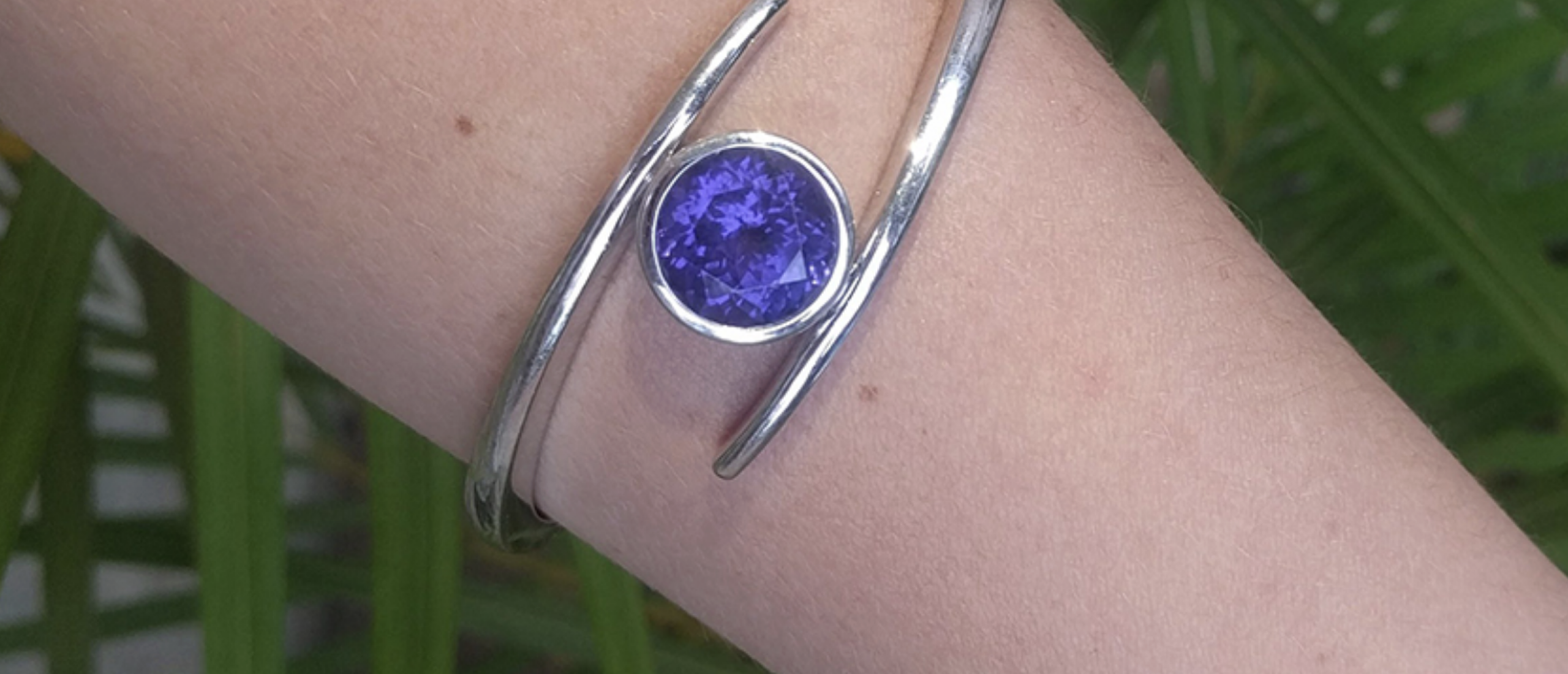

One of the most beautiful souvenirs from Tanzania is also the rarest in the world
When you think of a Tanzania safari, you think of lions, elephants and the endless plains of the Serengeti. But there's something else that exists only in Tanzania - something you won't find anywhere else on Earth. The tanzanite gemstone: a deep blue to violet precious stone found exclusively in the Merelani Hills near Arusha and Moshi. Precisely the region where we live and work.
We're not jewellers, but we've lived within a stone's throw of the world's only tanzanite mines for over fifteen years. And we notice that almost every traveller who joins us on safari eventually asks: 'So what exactly is tanzanite?' This blog has all the answers.
Born 550 million years ago - and only discovered in 1967
Tanzanite is one of the newest gemstones on the market in terms of awareness, yet one of the oldest in terms of geological origin. The stone formed more than 550 million years ago at the foot of Kilimanjaro, through a rare combination of immense pressure, heat and the presence of the mineral zoisite with traces of vanadium - the element responsible for tanzanite's characteristic blue-violet colour.
The official discovery is attributed to Indian prospector Manuel de Souza, who found the stone in 1967 alongside Maasai warrior Ali Juuyawatu. De Souza initially believed he had found sapphire. It was later established as an entirely new variety of zoisite and given the name tanzanite, after the only country where it occurs.
Tanzanite owes much of its international fame to Elizabeth Taylor, who had the stone set in her jewellery and introduced it to a wide global audience. Since then, tanzanite has grown into one of the most coveted gemstones in the world.
Tanzanite: 1,000 times rarer than diamond
It sounds almost unbelievable, but tanzanite is estimated to be a thousand times rarer than diamond. The reason is simple and absolute: tanzanite exists in just one location on Earth. A single deposit, approximately 7 by 2 kilometres in size, in the Merelani Hills near Kilimanjaro. It has never been found anywhere else on the planet - and geologists consider it virtually impossible that it ever will be.
What makes its rarity even more striking is that the current reserves in the mines are expected to be exhausted within a matter of decades. This makes tanzanite not only a beautiful gemstone, but also one with potential as a long-term investment - though we always recommend consulting an expert before making any purchase decision on those grounds.
💎 Did you know this about tanzanite?
Tanzanite is trichroic (pleochroic): a raw stone displays three different colours depending on the angle from which you view it - purple, blue and red-brown. Only after cutting and polishing does the dominant colour - deep blue to violet - fully emerge.
The colour of tanzanite: from pale violet to royal indigo
Tanzanite's appeal is largely defined by its extraordinary colour. Depending on quality and cut angle, it ranges from pale violet and lilac to a rich, deep indigo blue. The most valuable stones display an intense, saturated blue-violet hue that appears to shift in changing light.
The colour is sometimes enhanced by heating to 400–500 degrees Celsius. This is a standard and accepted treatment within the industry, which reduces the reddish undertones and intensifies the blue. Most tanzanite stones found in jewellery have undergone this treatment.
The 4 C's of tanzanite: how value is determined
Just as with diamonds, the value of a tanzanite gemstone is determined by four factors - the 4 C's. The Tanzanite International Grading System uses the same criteria as the International Gemological Institute of America applies to diamonds: colour, clarity, cut and carat.
C Colour
The intensity and saturation of the colour, ranging from pale (Pale) to exceptionally deep blue-violet (Exceptional). The colour code uses 'B' (blue dominant) or 'V' (violet dominant). The more intense and saturated the colour, the rarer and more valuable the stone.
C Clarity
The degree of inclusions and imperfections within the stone, from Eye Clean (no visible inclusions to the naked eye) to Heavily Included (visible dark spots or crystals). The clearer and more transparent the stone, the higher its value.
C Cut
The quality of the cut determines how light travels through and reflects within the stone. An Excellent cut allows the facets to reflect light optimally. The more precise the cut, the greater the brilliance and the higher the value.
C Carat
The weight of the stone expressed in carats (1 carat = 0.2 grams = 100 points). Two stones that look identical can have different carat weights if they differ in depth. Heavier stones of equal quality are exponentially more valuable.
What does tanzanite cost? An honest price guide
The price of tanzanite varies enormously depending on colour, clarity, cut and weight. As a general guide:
- Small stones (under 1 carat) of average quality: from $50–$150 per carat
- Mid-range stones (1–5 carats, good colour and clarity): $200–$600 per carat
- Top quality (5+ carats, intense blue colour, Eye Clean): $800–$1,500+ per carat
- Exceptional stones (10+ carats, Exceptional colour): can reach several thousand dollars per carat
A word of caution: tanzanite offered on the street or at a market for a very low price is almost certainly not what it appears to be. Always buy from a certified dealer who can provide a certificate from a recognised gemmological institute.
Tanzanite also carries spiritual significance
Tanzanite is the official birthstone for December, and that's no coincidence. In Tanzania, the stone has always carried deep meaning, long before Western traders discovered it. The Maasai regard tanzanite as a stone of good fortune, transformation and new beginnings. Newborn children are traditionally blessed with tanzanite as a symbol of strength and a prosperous life.
In the Western gemstone world, tanzanite is associated with calm, depth and spiritual growth. Whether or not that resonates with you - the extraordinary colour alone makes it a stone that demands attention.
Buying tanzanite in Tanzania: what to watch out for
If you're considering buying tanzanite during your trip, a few things will make the difference between a wonderful purchase and a disappointment:
✅ Only buy from a certified jeweller or accredited dealer - never from street vendors
✅ Always ask for a certificate from a recognised gemmological institute (e.g. IGI or GIA)
✅ Don't be pressured by urgency or 'last chance' stories - reputable sellers stand behind their product
✅ Compare prices at multiple shops before making a decision
✅ Be especially cautious with stones offered as 'raw tanzanite' - authenticity is difficult to verify without expertise
✅ Check the import regulations in your home country for gemstones and jewellery
We're not gemstone experts ourselves, but we've lived in this region for over fifteen years and know several trustworthy addresses in Arusha and Moshi. Feel free to ask us, we're happy to point you in the right direction with no commercial interest whatsoever.
Tanzanite: a lasting memory of your Tanzania journey
A tanzanite gemstone may well be the most beautiful souvenir you can bring home from Tanzania - not because of its price, but because of its uniqueness. This stone exists nowhere else on Earth. The stone you carry home was formed in the same place where Kilimanjaro rises above the clouds, where the Maasai herd their cattle and where the Serengeti stretches endlessly to the horizon.
Whether you buy it as a personal keepsake, a gift for someone you love, or a small investment in something truly rare - a tanzanite gemstone carries the story of Tanzania within it. And that story begins right here.
Plan your Tanzania safari with Makasa and discover the stone that exists only here.