We have lived in Tanzania since 2009 and run Makasa since 2010, and every week we sit down and decide where somebody with two weeks should go. So here are the ten, and underneath them the three places we leave off on purpose. Written in Moshi, at the foot of Kilimanjaro, from the road rather than from a map.
The leaving out is the part worth reading. Two weeks does not hold everything this country has, and the choices you make about what to drop are what decide whether the trip works. You may as well see how we make them.
The highlights of Tanzania, and how we chose them
One test, and only one. Would we send somebody on their first trip here to this place.
The first five are in almost every route we build. The next five are on the list for a different reason, which is that those are the days guests write to us about a year later.
How far apart they are and how many days each one needs is a separate question, and it is on our safari page rather than here.
1. Serengeti National Park
Fourteen thousand seven hundred and sixty three square kilometres, about 5,700 square miles, of grass. That number means nothing until you have driven across it for an hour and the horizon has not changed.
More than a million wildebeest and a few hundred thousand zebra move through it in a circuit that never stops, which is the great migration, and it is the reason most people come.
Where they are depends on the month. December to March they are in the south around Ndutu, where the calves are born. June to October they are in the north, which is where the river crossings happen. The centre has animals all year, and that is also why it is the busiest part of the park.
Our own camps are in the north. We put them there because it is quieter, and because when the herds are up there you are already in position rather than driving four hours to reach them.
2. The Ngorongoro Crater
A collapsed volcano about 20 kilometres, roughly 12 miles, across, with a flat floor where an estimated 25,000 animals live permanently. They stay rather than move because there is water and grazing down there all year, which is why you see so much in so small a space.
It is also one of the few places in the country where black rhinos still live. Usually out on the floor at a distance, and rarely close, and that is worth knowing before you go in hoping.
On the road between the crater and the Serengeti lies Olduvai Gorge, where the Leakeys found what they found, and where you are looking at roughly two million years of layers in a wall. There is a small museum and half an hour is enough. You pass it anyway, so stop.
3. Kilimanjaro, with or without the climb
Some people come to climb it, and if that is why you are coming, climb it. Most people see the mountain without climbing it, and that is also enough, which is not what the climbing companies will tell you.
5,895 metres, 19,341 feet, the highest mountain in Africa and the highest free-standing mountain in the world. You can see it from Moshi, where we live. Early morning and the last hour before sunset are when it is out, because it builds its own cloud during the middle of the day and hides behind it.
And you can walk up onto it for a day without going anywhere near the summit, which almost nobody realises is an option.
4. Zanzibar and Stone Town
A short flight from the mainland, and the reason most of our trips end at the sea rather than at an airport. You come off safari dusty and tired and you have somewhere to put that down for a few days.
Stone Town is the old trading town, a UNESCO World Heritage Site, and it is a place of narrow streets and carved doors where the spice trade and the slave trade are on the wall of almost every corner you turn. It is not a beach destination and it should not be treated as one.
Then the coast. A reef offshore, a tide that remakes the beach twice a day, and a real choice to make between the busy stretches and the quiet ones, because they are not the same holiday.
5. Tarangire National Park
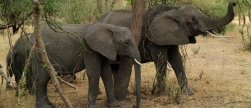
The highest density of elephants on the northern circuit, and baobabs standing in groups of hundreds. It does not look like anywhere else in Tanzania, and people who arrive expecting a smaller Serengeti are always surprised by it.
June to October is when it works, because by then the Tarangire River is the only water for a long way and everything comes to it. In the wet months the animals leave and the park goes quiet, and we will tell you that rather than sell you a day there in April.
We often start a trip here. It is calmer than the Serengeti, the driving is short, and it gives you a day to learn how a safari day works before you are somewhere that matters more.
6. The Rift Valley trek and Lake Natron
This is our own favourite, and hardly anybody knows it exists. On four days of walking we have met almost no other travellers.
You walk from Empakai Crater down to Lake Natron, through the Rift Valley, past Maasai villages, over ground that is volcanic and looks it. Lake Natron is a soda lake, red from the microorganisms that can live in it, and it is the only place in East Africa where lesser flamingos breed with any regularity. Behind it stands Ol Doinyo Lengai, an active volcano, which the Maasai call the mountain of God.
There is no Big Five here. It is landscape rather than animals, and you are walking through it instead of driving past it, which is a different thing entirely and not everybody wants it.
It fits in front of the Serengeti and the Ngorongoro without doubling back on yourself, which is why it works as the opening of a route rather than an add-on at the end.
7. A balloon flight over the Serengeti
Picked up around five in the morning, in the dark and the cold. Half an hour watching the thing fill, and then you go up with the sun for about an hour, sometimes a hundred metres, about 330 feet, sometimes much lower, with nothing to hear but the burner. Breakfast laid out in the grass wherever you come down.
And the honest part. It is the most expensive hour of the trip and it costs you a morning in the vehicle, which is a real trade rather than a free extra. The people who do it tend to describe it afterwards as the hour they remember longest. Both of those things are true at once.
8. Sleeping among the animals, without walls
The difference between seeing animals and sleeping among them does not show up at dinner. It shows up at two in the morning.
Canvas and a zip, and no walls. Hyenas go past. A lion roars and you have no idea whether he is two miles away or three hundred yards, because sound travels differently here and your instincts for it are built for somewhere else. Then it stops, and you lie there listening to how quiet it is.
You are walked to your tent at night and collected in the morning, and that is how every good camp in Tanzania works, ours in the northern Serengeti included. It is not roughing it and it is not dangerous. It is the one part of a safari that people cannot explain properly when they get home.
9. A day and a night with the Maasai
An hour at a boma, with dancing and a bracelet to buy at the end, makes a good photograph. A full day and a night gives you something else, and the difference is not small.
You walk out with the livestock, you eat what they eat, and you sit by the fire at night with nothing scheduled. What gets talked about is school, and rain, and what things cost. Nobody discusses culture, which is how you know it is working.
Two places do this properly, the Maasai lodge in West Kilimanjaro and Osiligilai at the foot of the mountain. Both are a night, not an hour, and that is the whole point.
10. The chimpanzees of Mahale and Gombe
Almost nobody books this, which is exactly why it is on the list.
Mahale and Gombe sit on Lake Tanganyika in the far west, a long way from everything else in this article. You fly, and then you go by boat, because no road reaches either of them. You sleep on a beach with mountain rainforest standing up behind you, and in the morning you walk into that forest behind wild chimpanzees.
Gombe is where Jane Goodall started in 1960, and the research she began there is still running. You are not visiting a monument, you are walking into a study that has been going for sixty-five years.
It is expensive, it costs days, and it does not belong in a first two-week trip. We have put it at number ten anyway, because it is the clearest way to show how large this country is and how little of it the northern circuit represents.
What there is to do in Tanzania besides looking at wildlife
This list is deliberately not all animals, because two weeks of animals is more animals than most people want.
There are coffee farms on the lower slopes of Kilimanjaro where the farmers take you from the bean to the cup in a morning. Stone Town is a thousand years of Indian Ocean trade standing in one square kilometre. And you can walk, in the Rift Valley, on Kilimanjaro, and out of Moshi into the villages, which is the cheapest and best thing on this whole page.
If you have two weeks, put at least two non-safari days in it. Otherwise you have spent a fortnight in a vehicle, however good the vehicle is. The easiest one to fit is a morning with the coffee farmers, and it goes in on a day you were going to spend driving anyway.
What we deliberately left off this top ten
Lake Manyara. A good-looking detour and a sensible stop on the way to the Serengeti, and not a destination in its own right. It is in our fourteen-day trip because it breaks a long drive and buys you half a day of animals, which is a logistics reason rather than a reason to come to Tanzania. We would rather say that than dress it up.
Nyerere and Ruaha. Large, quiet and very good, and in the south. The distances cost you days that the north spends on animals instead, so for a first trip we send people north. They belong on your second trip, and we do run that trip, so if the empty south is what you want, say so and we will build it rather than talk you out of it.
Olduvai Gorge. Not here as a separate entry only because it sits inside the Ngorongoro area and you drive past it on the way. It is under number two, and it is worth the half hour.
A list counts places off. A trip gives you time to be in them. Those are not the same holiday, and the second one is what we build.
Which of these ten fit into one trip
Not all of them, and they do not need to. Our fourteen-day route takes in six of the ten and finishes at the sea, which is about as much as two weeks will carry without turning into a series of drives.
Safari njema.